In the ever-evolving landscape of mobile technology, we've seen keyboards evolve, screens grow, and cameras rival professional equipment. But one fundamental interaction has remained largely unchanged for years: the touch screen. It's our primary interface, a glass surface we tap, swipe, and pinch to navigate our digital lives. What if you could control your phone without ever laying a finger on it? This is the intriguing proposition of Spatial Touch™, an app that aims to make air gestures a practical and powerful reality. With its recent complete overhaul, Spatial Touch has arrived in 2026 as a far more capable, efficient, and accessible tool, promising to free us from the shackles of the screen.
At its core, Spatial Touch is a gesture recognition system powered by on-device AI. It uses your phone's front-facing camera to track your hand movements, translating specific hand gestures into commands. The new version of the app has been completely rebuilt, introducing a more natural "pinch" gesture while significantly improving performance, stability, and response speed. This makes the experience less gimmicky and more fluid, bringing us closer to the futuristic interfaces we've seen in sci-fi movies. The core promise is simple yet powerful: you can control your phone from a distance of up to two meters, making it perfect for scenarios where touching your screen is impractical or impossible.
A Gesture Language for Your Phone
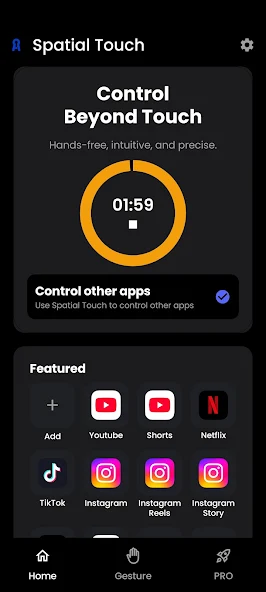
The app translates intuitive hand movements into a comprehensive set of commands. The core gestures are designed to mimic common touch interactions. A simple "tap" in the air can play or pause a video, while sliding your hand left or right controls fast-forwarding and rewinding. Moving your hand up and down adjusts the volume, creating a seamless, almost magical way to manage your media. For more complex navigation, there's a "secondary click" for functions like switching to full-screen mode or opening comments. The new pinch gesture adds another layer of intuitive control, making actions like zooming or scrolling feel more natural. For Pro users, a "pointer mode" is available, allowing you to control a virtual cursor to interact with any on-screen element, effectively giving you a mouse-like experience without the hardware.
The Power of On-Device AI
A crucial aspect of Spatial Touch is its commitment to privacy. The app uses "on-device AI," meaning all the data processing from your camera feed happens locally on your phone. Your video feed is not uploaded, stored, or analyzed in the cloud. This is a significant advantage over other gesture-control solutions, as it ensures that your privacy is maintained. The recognition is happening in real-time, right on your device, which is what makes it fast and responsive. This architecture is a smart approach to a sensitive application, as it circumvents the privacy concerns that often plague apps that require camera access.
Key Features and Supported Apps
- Core Gestures: Tap (play/pause), Left/Right Swipe (seek), Up/Down Swipe (volume), Secondary Tap (fullscreen/menu), Pinch (zoom/scroll).
- Pro Features: Pointer mode for cursor control, expanded app support, ad-free experience, and always-on functionality.
- Supported Apps: Optimized for major platforms like YouTube, Instagram, TikTok, Netflix, Disney+, Spotify, and more.
- Privacy: On-device AI processes all video data locally, ensuring no data is stored or uploaded.
- WebView Mode: Allows use in YouTube without needing to grant accessibility permissions.
The User Experience and Performance
The transition to a completely new architecture is a bold move that appears to have paid off. The developer boasts a significant reduction in power consumption and device heating, as well as better support for low-spec devices. This is critical for a feature like this, as running a camera constantly can be a battery drain. Users are reporting a much faster and smoother experience, making it more practical for everyday use. The ability to choose between the standard sensor mode and the new WebView mode gives users flexibility and control over their permissions, which is a thoughtful design choice that addresses the friction of granting accessibility permissions.
The Verdict: A Glimpse into the Future of Interaction
Spatial Touch is one of the most innovative and forward-thinking apps to hit the Android ecosystem in 2026. It takes a concept that has often been a novelty and polishes it into a genuinely useful and reliable tool. The potential applications are vast: cooking while following a recipe on your phone, giving a presentation without touching a device, or simply lying in bed and effortlessly scrolling through content. The commitment to on-device AI processing is commendable and addresses the privacy concerns that such an app would naturally evoke.
While the app's effectiveness is dependent on lighting conditions and the camera quality of your device, the progress made is undeniable. The comprehensive overhaul has transformed it into a stable and responsive tool that feels like a glimpse into the future of human-computer interaction. For early adopters and anyone who wants to push the boundaries of how they use their phone, Spatial Touch is a must-try application. It is a powerful example of how we are moving beyond the screen, and how our devices are learning to interact with us in more natural and intuitive ways.