In the modern smartphone era, the battery is our device's beating heart. We obsess over charging speeds, screen-on time, and the inevitable day when we need to replace the battery. This obsession has given rise to a niche but essential category of apps dedicated to monitoring battery health and usage. Among these, AccuBattery has emerged as a clear leader, with over 10 million downloads and a stellar 4.7-star rating from nearly 600,000 users . Developed by the small, independent team at Digibites, it promises a scientific approach to understanding your battery. But in a world of complex physics and hardware variables, can a simple app truly provide accurate, actionable insights, or is it a sophisticated estimate that sometimes misses the mark?
The core value proposition of AccuBattery is its focus on battery health and capacity. Unlike the often-misleading "percentage remaining" that your phone provides, AccuBattery aims to measure the actual battery capacity in milliampere-hours (mAh). By monitoring the voltage and current during charging, the app calculates the total energy that goes into the battery and compares it to the manufacturer's original design capacity. This provides users with an estimate of how much their battery has degraded over time, a key metric for deciding when a replacement is necessary. The app also offers a feature to alert you when your phone reaches a certain charge level, helping you avoid overcharging, which can accelerate battery wear .
A Feature Set Designed for Power Users
AccuBattery's features go far beyond a simple health percentage. It provides detailed, real-time monitoring of your device's power consumption, breaking down usage by individual apps. This is a powerful tool for identifying battery-draining culprits that might be running in the background . The app also offers practical insights like estimated screen-on and standby times based on your personal usage patterns, helping you plan your day around your phone's needs. The charging speed analysis is another popular feature, allowing you to test different chargers and cables to find the fastest combination for your device.
Key Features at a Glance
- Battery Health: Estimates remaining battery capacity (mAh) and displays wear over time.
- Usage Monitoring: Tracks and reports power consumption per app, screen-on time, and standby estimates.
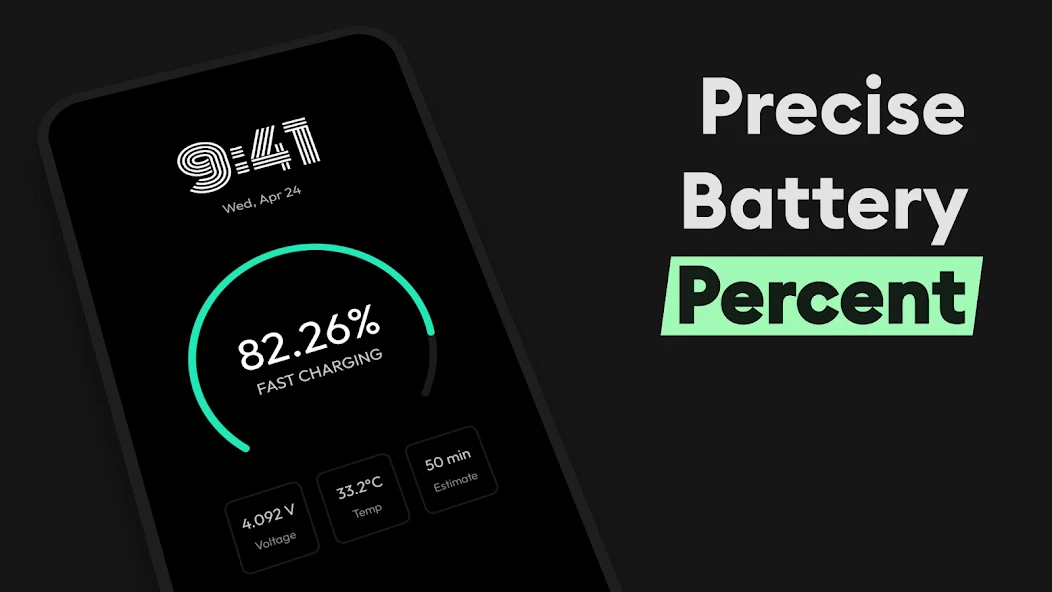
- Charging Analysis: Displays real-time charging speed (mA) and estimates time to full charge.
- Charge Alarms: Notifies you when a selected charge level (e.g., 80%) is reached to help preserve battery life.
- Historical Data: Stores detailed charging history to track long-term battery trends (Pro feature).
The User Experience: A Tale of Two Opinions
User reviews for AccuBattery reveal a fascinating split in opinion that highlights the app's complex nature. On one side, a large and passionate group of users praise it as an indispensable tool, calling it "the only app that can reliably measure battery health" and a "must-have for any smartphone ." These users often cite its ability to provide detailed insights and its utility in making informed decisions about battery replacement. They appreciate the science-driven approach and the wealth of data provided.
On the other side, a vocal group of users, particularly those with newer or specific smartphone models, criticize the app's accuracy, sometimes labeling it a "piece of entertainment" akin to benchmark testers. A common complaint is that the battery capacity estimation can be inconsistent and is highly sensitive to usage patterns and phone state during charging . For instance, the app does not function when the phone is completely shut down and charging, and its calculations can be thrown off by interruptions like screen-on time during the charging cycle . Some users have reported that the app fails to detect a complete charge cycle, leading to wildly inaccurate health readings, which understandably undermines trust .
The Developer's Approach and the Science Behind It
The developers at Digibites are transparent about their methodology and the inherent complexities of battery measurement. They acknowledge that the app's calculations are estimates, based on data from the phone's own battery management system. This data can be influenced by numerous factors, including temperature, the age of the battery, and the phone's own power management algorithms. The developers actively work to improve the app's algorithms, as evidenced by recent updates that improve the handling of long charging sessions and special battery features like Sony's 80% charge limit . This commitment to refinement is a positive sign, demonstrating that the team is actively listening to feedback and addressing technical challenges.
The Verdict: A Powerful Tool, But Not a Magic Crystal Ball
AccuBattery is a sophisticated and powerful tool for anyone looking to understand their smartphone's battery behavior. For the average user who wants to track general battery health and identify power-hungry apps, it is an invaluable asset. Its charge alarm feature alone can be a practical step towards extending battery life. The app's focus on science and its active development community make it a reliable source of data.
However, it is critical to approach its data with a measured understanding. The app provides estimates, not absolute truths. The health percentage is a derived metric that can be influenced by many variables, and it is best used to observe trends over time rather than as a single, definitive number. Users with highly optimized, modern smartphones might find that the app struggles to provide consistent, meaningful data due to the advanced power management systems in those devices. It is also worth noting that the app collects certain data, including location and device information, which is a consideration for privacy-conscious users . Ultimately, AccuBattery is an excellent guide for the health of your battery, but it should be viewed as a compass, not a precise map. It provides the direction, but you must interpret its readings within the context of your own usage and device specifics.